The Conversion Problem Smaller Ecosystems Can't Afford to Ignore
Why the gap between technical capability and production deployment is where AI value capture is actually being decided

The numbers coming out of Southeast Europe’s AI ecosystem are increasingly difficult to dismiss.
Serbia and North Macedonia are the Western Balkans countries selected for the EU’s AI Factory antenna program - part of a €200 billion public-private initiative combining €50 billion in EU funding with €150 billion in private capital. Serbia reports that 97% of IT companies are using AI and 90% of IT professionals use it daily. More than half of startups are integrating AI into their products, up 10% year over year. Croatia reports that roughly half of companies use AI in daily work and more than €1 billion was invested in AI in 2023 alone. Slovenia is building a national AI Factory with 2,400 GPUs and has roughly €500 million in available venture capital. Albania jumped 16 places in the Global Innovation Index in 2025 while startup funding grew 50% year over year.

A few years ago, most of these numbers would have sounded aspirational.
Today, Southeast Europe is no longer debating whether AI matters.
At the inaugural SEE AI Summit 2026 in Novi Sad, the conversation had already shifted toward compute, deployment, regulation, commercialization, and production infrastructure.
National studies across the region capture the transition clearly.
But one number kept pulling me back.
Thirty-four percent.
That is the share of enterprises in Serbia actually using AI in business operations. Not experimenting with tools. Not individual employees using ChatGPT. Actual company use. Croatia’s research found that 75% of companies cite lack of knowledge as the primary barrier and only 5% regularly train employees on AI. A Goldman Sachs Small Business AI Adoption Survey from March 2026 found that while 76% of businesses claim to use AI, only 14% have integrated it into core operations. Chatbots and RAG systems still dominate production deployments, agentic workflows remain early, and there are still no truly AI-native companies emerging from the region at scale. High adoption at the individual level. Near-zero deployment at the organizational level.
That gap is the actual story.
What the numbers are measuring
The 97% figure is probably real and meaningful. It tells AI tools are accessible and that technical professionals in Serbia (and likely in the other Southeast European countries ) are adopting new ways of working faster than most expected. But it does not mean that organizations are changing.
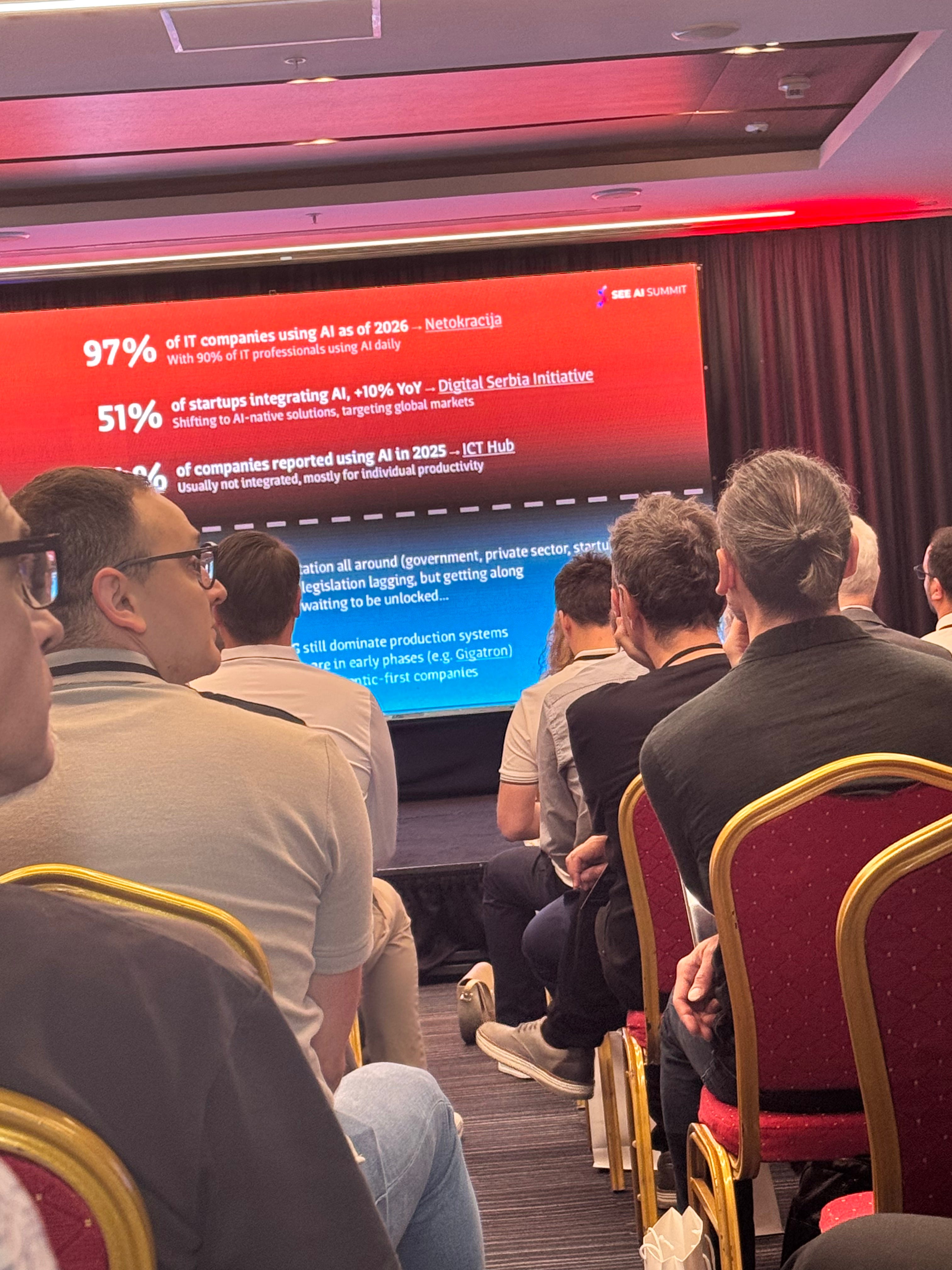
A developer using AI-assisted coding tools every day is not the same thing as a company running AI-powered operations at scale. While one measures individual productivity, the other measures organizational capability. National studies across the region capture the transition clearly: the countries in SEE region are no longer asking whether AI matters - the challenge now is how to implement, finance, govern and scale it strategically.
Most SEE AI ecosystem activity is still optimized for events, accelerator programs, policy frameworks, while founder communities are largely organized around introducing AI rather than operationalizing it. Implementation still requires process change, organizational commitment, technical integration, and the kind of trust that takes time and repeated deployment to earn.
The implementation gap is a production readiness problem - the ability to move a working prototype into a deployed system that customers depend on, enterprises trust, and teams can operate within predictable cost constraints.
The infrastructure investment is real - and scale context matters
Across the region, governments are making their first serious compute commitments. Serbia’s National AI Platform completed a major hardware expansion in May 2026 - roughly €40 million, 720+ GPUs operational, with a roadmap to 2,000 by 2030 and 5,000 by 2035. North Macedonia’s VEZILKA initiative connects startups and researchers directly to EuroHPC infrastructure, offers free HPC access to companies in the proof-of-concept phase, and has begun training roughly 3,000 civil servants across government. Slovenia’s national AI Factory is under construction as part of the same European infrastructure program, adding 2,400 GPUs to the regional compute base. Serbia and North Macedonia were the only Western Balkans countries selected for the EU AI Factory antenna network — part of a €200 billion public-private initiative that is reshaping where serious AI infrastructure gets built in Europe. These are serious institutional bets backed by national budgets and implementation programs, not just policy documents.
But the scale gap is real and worth naming directly.
A single frontier AI training cluster at a major US or Chinese technology company can exceed 100,000 GPUs. The largest players are competing on capital expenditure, energy infrastructure, and compute density that most countries cannot realistically match - not just in SEE. IEA projections put global data center electricity consumption roughly doubling to around 945 TWh by 2030, driven by infrastructure buildouts that require sovereign-level resource commitments.
Sovereign compute may be worth building, but it is not sufficient as a strategy on its own.
An ecosystem can have sovereign compute and still run every production workload on hyperscaler platforms - training its developers on external models, designing governance structures that assume continuous API access to systems it does not control, and building companies whose critical architecture decisions were made elsewhere. The hardware exists. The dependency remains.
Infrastructure can create conditions, but it will not automatically create companies.
Where the SEE region has a genuine edge
National government initiatives in the region sound interesting, but the SEE’s real proof lies in its AI startups - specifically those few that secured seed funding or even a Series A before an acquisition. Croatian startups such as Daytona and SPLXAI demonstrate what this looks like in practice. One is building infrastructure for AI agents. The other focused on enterprise AI security before being acquired by Zscaler. Neither succeeded because they were regional companies. They succeeded because they competed globally at the critical infrastructure and security layers of AI.
The region’s unfair advantage is its technical depth paired with a powerful diaspora network. Decades of brain drain have inadvertently created a strong, unmapped network of global researchers, founders, executives, and engineers. From senior leadership at Nvidia to faculty positions at Stanford and UC Berkeley, the diaspora reflects a fifty-year tradition of technical and research excellence.
SEE ecosystem is incredibly difficult to replicate because the network is already live. The only missing piece is the organizational structure needed to help it compound globally rather than stay fragmented and personal.
The thesis
The next challenge for SEE AI ecosystems is converting its technical capability into production infrastructure, founder density, deployable market access, and durable commercial outcomes - before dependence on external platforms becomes the default.
The risk facing these ecosystems is often framed as falling behind. But I think the actual risk is different. An ecosystem can have rising AI adoption rates, active conferences, growing startup communities, and genuine infrastructure investment while simultaneously becoming more dependent on external platforms for every critical layer of the stack. The default cloud and deployment architectures come from elsewhere - and the best technical talent eventually exits to elsewhere.
None of that looks like failure, especially while individual adoption numbers are strong.
That is precisely why the conversion problem matters. Technical capability that does not become organizational capability and commercial density does not disappear - it migrates.
The SEE policy infrastructure, the technical talent, the diaspora reach, the early exits, and the growing international partnerships are real. The gap remains in the organizational layer between individual contributions and systematic capability-building.
What the SEE ↔ SF Bay Area bridge is actually worth
I am based in Berkeley.
After time spent in both ecosystems, one observation keeps resurfacing. The talent quality gap between Southeast Europe and the Bay Area is far smaller than most people assume. The density gap is real and the confidence gap is much larger.

While the technical work often holds up, the harder part is commercial fluency - how to enter a Bay Area market conversation, how to frame a company for US investors and customers, how to convert warm introductions into durable relationships, how to navigate markets where distribution frequently matters as much as technology.
I still believe that those capabilities exist in the region, but they are not yet distributed at scale.
And the diaspora bridge is one of the most underused assets still available. There are people from Southeast Europe working inside leading research labs, infrastructure companies, venture firms, universities, and technology companies across the US. Many maintain real connections to the region and countries where they are from. But only few ecosystems outside of the US have figured out how to systematically leverage those relationships - to run founders across that bridge in both directions, with real market access and infrastructure connections rather than just introductions.
The ecosystems that build that operational infrastructure will have an advantage that extends beyond any individual company or funding round. Not because of the connections themselves, but because of what systematic pathways produce over time.
Personal networks don’t compound, at least not at scale.
And the SEE ↔ SF Bay Area bridge is ultimately about that compounding:
Converting technical talent into production companies.
Converting infrastructure investments into commercial density.
Converting diaspora reach into organized market access.
The ecosystems that solve these conversion problems will capture far more value than their size suggests.
The ones that don’t may find themselves contributing talent to the future without helping shape it.
From Berkeley. From inside the rooms.